
Rock Climbing
Sports Information Menu |
|---|
| Archery • Baseball • Basketball • Bowling • Cycling |
| Football • Golf • Hockey • Lacrosse • Paintball |
| Racquetball • Rock Climbing • Scuba Diving |
| Skateboarding • Skating • Skiing • Soccer |
| Softball • Squash • Surfing • Tennis • Volleyball |
Recent Rock Climbing News
- Rock climbing gym proposed in Miami-Dade County
There are currently only 2 other rock climbing gyms in the county.
Brian Bandell. American City Business Journals. Wednesday, 13 Dec 2023 19:19:18 +0000. - University of Georgia student tragically dies in rock climbing fall
A University of Georgia student from Michigan fell to her death while rock climbing with her gym in Alabama.
Fox News. Friday, 20 Oct 2023 19:14:24 -0400.
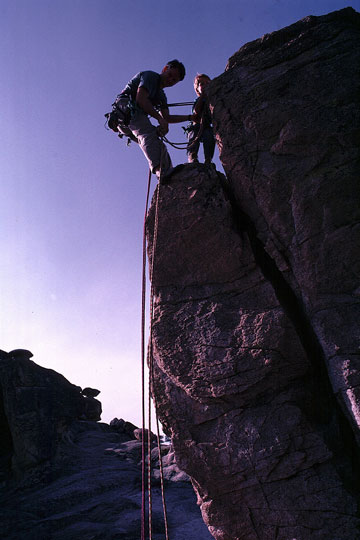 Outdoor rock climbing is practiced on cliffs ranging from 33 to 3300 feet
in height. Experienced climbers usually climb in pairs. One
climbs while the other belays, or feeds the rope to the lead climber
through a belay device. This is known as "lead climbing." "Bouldering" is a term
used to describe the way that outdoor climbers practice before an actual
climb. Difficult climbing moves are practiced without ropes and
hardware on boulders or rock outcroppings several feet above the
ground. "Top-roping" is a technique used to ascend cliffs less than 160 feet
high. The climber is anchored from above. On higher cliffs,
more than one rope length must be used, and this is referred to as
"multipitch" or "continuous climbing." Rock climbing movements
include "friction climbing" (moving up smooth, low-angled rock slabs);
"face climbing" (using knobs and edges to ascend a sheer wall); "crack
climbing" (placing hand and feet into fissures in the rock); and
"overhang climbing" (utilizing bursts of energy and muscle to swing past
overhangs). Rappelling is often used to move back down the face to
the bottom of the cliff.
Outdoor rock climbing is practiced on cliffs ranging from 33 to 3300 feet
in height. Experienced climbers usually climb in pairs. One
climbs while the other belays, or feeds the rope to the lead climber
through a belay device. This is known as "lead climbing." "Bouldering" is a term
used to describe the way that outdoor climbers practice before an actual
climb. Difficult climbing moves are practiced without ropes and
hardware on boulders or rock outcroppings several feet above the
ground. "Top-roping" is a technique used to ascend cliffs less than 160 feet
high. The climber is anchored from above. On higher cliffs,
more than one rope length must be used, and this is referred to as
"multipitch" or "continuous climbing." Rock climbing movements
include "friction climbing" (moving up smooth, low-angled rock slabs);
"face climbing" (using knobs and edges to ascend a sheer wall); "crack
climbing" (placing hand and feet into fissures in the rock); and
"overhang climbing" (utilizing bursts of energy and muscle to swing past
overhangs). Rappelling is often used to move back down the face to
the bottom of the cliff.
Free climbing and aid climbing are two types of rock climbing. Free climbing uses equipment only as a precaution, and mainly relies on the climber's fingers, hands, arms, legs, and feet to scale the cliff. In aid climbing, ropes and hardware are used to support the climber's body weight.
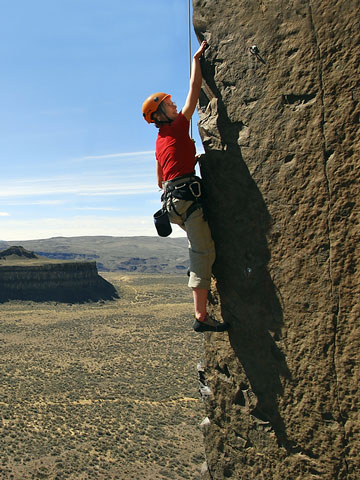 Many rock climbing faces are given a difficulty rating; in the United
States, as rated by the
Yosemite Decimal System, it ranges from 5.0 (easiest) to 5.15
(hardest). Three factors taken into consideration in a rating system
are the difficulty of the hardest move, the stamina needed to climb
the route, and the danger of the climb.
Many rock climbing faces are given a difficulty rating; in the United
States, as rated by the
Yosemite Decimal System, it ranges from 5.0 (easiest) to 5.15
(hardest). Three factors taken into consideration in a rating system
are the difficulty of the hardest move, the stamina needed to climb
the route, and the danger of the climb.
Necessary equipment includes a climbing harness, rope, belay, and one or more carabiners. Special shoes made of leather or synthetic materials with sticky rubber soles are recommended, as is a helmet for outdoor climbs. Layers of lightweight clothes work best for outdoor climbs, where shorts and a t-shirt are usually sufficient for climbing indoors.
Rock Climbing Information Resources
All rights reserved. About Us.